Saturday, November 7, 2009

ROUND TWO! READ!

If I read 60 books this year, does it count as reading fifty each year?

1. The Gathering Storm- Robert Jordan and Brandon Sanderson
2. Snow Crash- Neil Stephenson
3. McSweeney's Thirty-Two- Various Authors
4. Inventory: 16 Films Featuring Manic Pixie Girls, 10 Great Songs Nearly Ruined by Saxophone, and 100 More Obsessively Specific Pop Culture Lists- The A.V. Club
5. The Boy Detective Fails- Joe Meno
6. Inherent Vice- Thomas Pynchon
7. The Girl with the Dragon Tattoo- Stieg Larsson
8. Black Hole- Charles Burns
9. The Satanic Verses- Salman Rushdie
10. Devil in the White City- Erik Larson
11. Born Standing Up- Steve Martin
12. The Girl Who Played with Fire- Stieg Larsson
13. The Corrections- Jonathan Frazen
14. Zeitoun- Dave Eggers
15. Killing Yourself to Live- Chuck Klosterman
16. Invisible Cities- Italo Calvino
17. Haroun and the Sea of Stories- Salman Rushdie

The Beginning of the End (Not That Anyone Else Cares)


I don't think there's anything else in literature quite like the sprawling fantasy epic series. Sure, there are serial novels, and novels featuring the same character over and over again (Agatha Christie and the "Do something for something else alliterative" novels come to mind) but while those may build on each other and carry over, Fantasy epics tend to focus on exactly the same characters, with the arcs and storylines carrying over from book to book, cliff hangers abounding. You may have to wait to or three books just to see the next chapter about the character you were enjoying so much in book four, and every time something seems resolved, some other plot crops up, or the overarching plot comes back in. In this sense, its more like serialized television then anything else. Like watching Lost or Battlestar Galactica, the narrative follows a point beginning to end, and if you don't stay with it til the very very end, you won't know how it turns out. Sure, you can drop in and out, but if you are a devoted follower, you need to know every detail, and keep track of every thread, and to do that, you need to keep up. But unlike Lost where you may have to wait a week, or at worse, nine months, in between, fantasy epics that are still being written can take years from book to book, and you find that in order to really be ready for book 12, you have to remember everything from books 5 and 7 and 9, and you don't. Hence, rereading the first 11 (last year) in preparation for this one (this year).

As this is the only WoT book I will read this year, I'll indulge in a fuller post than I usually do for these. The major thing about this book is it is the first of the series released after series creator and author of the first 11 books (and prequel), Robert Jordan. Jordan died in 2007, while he was well into writing what was supposed to be the final installment in WoT. As tragic as his death was (both for his friends and his fans) he supposedly left copious notes detailing how the series wound up, and even wrote the final chapter or some already. Enter Brandon Sanderson, a random fantasy writer tapped by Jordan's wife and editors to complete his opus. I was concerned before cracking the book...as excited as I was, and as much as I want (nay, need) to see how everything plays out...does Rand survive Tarmon Gai'dan (the mythic and much promised final showdown betwee the forces of the Dragon Reborn [good] and Shai'tan, the Dark One [evil])? Do Perrin and Faile reunite blissfully? What happens to Mat? does he find and rescue Moriane? Who is Verin, really? Where are the remaining Forsaken? What is Cadsuane's deal? Etc, etc...I was worried that the styles wouldn't mesh, the choices would seem odd, or worse, that they would seem to betray the nearly ten thousand words (and what feels like an equal number of reading hours) devoted to setting them up. But, thank the light, my worries were mostly for naught. The style is different, here and there (mostly in terms of dialogue with a more modern vernacular...characters using words like "ain't" or starting sentences with "Look..." where they didn't with Jordan) and some small choices are circumspect, but mostly it seems to like trudging down the same path I've been on for some time. And that's a good thing. Even with the end in sight.

Go ____ Yourself: an exercise in style


I've seen The Big Sleep, and I've read a good solid handful of books that follow Chandler's style (and a healthy handful of films as well, plus I think we're all familiar with the dozens of outright parodies that are out there). But I'd never read the book itself until I grabbed it while looking fruitlessly for the first installment in James Ellroy's Underworld USA trilogy (which I haven't read since high school and want to revisit en route to reading his final entry, just published). And those circumstances are pretty appropriate, given that Ellroy's style looks a lot closer to Chandler's than I would ever have imagined.

This is really great hard-boiled style, which is probably the most obvious thing you can say about it, but it's really pleasantly surprising just how sharp it still seems, SEVENTY YEARS after its publication. Chandler deals with a lot of grime here -- blood, guts, vomit, seduction, nudity -- that doesn't seem shocking until you reach a chapter where a young homosexual (hey, that sure didn't make it into the movie!) repeatedly tells Marlowe and anyone else he happens to meet "Go fuck yourself." Only Chandler, for obvious reasons given the era he was writing in, renders it as "Go ___ yourself." And then proceeds to spin pure gold from it over and over again; once he's established the kid's vernacular, he calls it back repeatedly ("He made a suggestion," one cop drawls, spitting and saying "I'm letting it drift") to increasingly sharp effect.

So there's a lot of that. There's a lot of stellar verbal sparring. You forget that not only don't they write movies with this crackling dialogue much any more, but they don't write much of anything like this any more. "You should see him sober. I should see him sober. Somebody should see him sober. I mean, just for the record. So it could become a part of history, that brief flashing moment, soon buried in time, but never forgotten -- when Larry Cobb was sober." I mean, the book is littered with throwaway lines like this. It's delight, pure and simple.

So you know, I'm still looking forward to that Ellroy, but I gotta say, he's got a lot of surprising-me to do if he's gonna out-grit Chandler. This was rip-snorting good readin'. More like it, please!

Two Serious Men


So after seeing A Serious Man (SEE IT, guys, it's great), and reading a truly excellent AV Club interview with the brothers Coen, I wanted to dig into this book of interviews and critical responses to their films. Published in the wake of Big Lebowski (and with a few of the later interviews in the piece hinting at what would become O Brother Where Art Thou), it's pieced together out of chronological pieces on, with, and about the Coens. Which is interesting, to a degree (seeing how Blood Simple was received and how they were perceived in interviews then as opposed to by the time Fargo came out), but ultimately leaves the book pretty short on context or reflection. There's an interview series I flipped through in a Berkeley bookstore about a year ago (I remember a Mike Leigh installment in particular) compiled of interviews one single author did with directors over the course of their career, and that seems like a much more fruitful approach -- a cumulative effect with much less redundancy and thin focus. Throw in the fact that most of these reviews aren't, say, Rosenbaum-esque Considerations Of Films (in fact, many are culled from Variety and Hollywood Reporter and include predictions of fiscal success or failure) and you have a pretty thin, unsatisfying volume. Frankly, you're a lot better off reading that AV Club piece to get a sense of the brothers that doesn't come with a gloss of incredulous "BROTHERS who make movies TOGETHER? What a country!"

Guys! It's the start to an exciting new year where I complain a lot! WHO'S JAZZED ABOUT THIS? ...JUST ME? Okay, well stick around, this next book blows the friggin' roof off with excellence and style.

UPDATE: This is the book on the Coens in the Interviews series I mention above. Might check it out if I have the time and inclination, though I'm actually much more interested in the Mike Leigh and Robert Altman installments. Intrigue!

Post-mortem, or SHAAAAAME

Well, quite a bit shy of 50, but tell you what gang, this was a swell yearlong project if only for keeping me focused on some "pleasure" reading in the midst of rehearsals, for-pay scriptreading, and the numbercrunching of an average day. Nice to keep a little pressure on an arena that I've always loved more than the things I Have To Do. SO! No grand promises or designs on hitting the mark this next year, but hells YES, I will give it another shot! And hey, I'm already two books in! (After a month of rehearsing a show while running another show, I'm almost overwhelmed by the sense of free time that comes with only doing one thing at a time.) So bring it on, my friends. And keep giving me sweet, sweet titles to add to the "yet to come" stack. I'd do summaries like all you clever cats, but I'm DONE with the shame of the past! On to the future! To glory! Et cetera!

Thursday, November 5, 2009

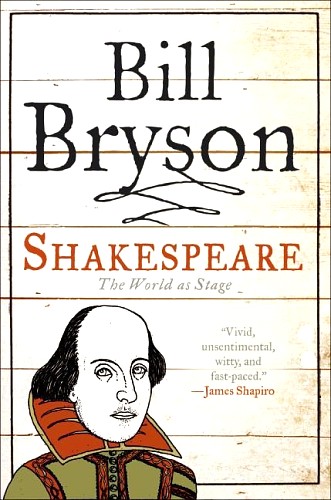
Shakespeare: The World as Stage by Bill Bryson

Or "Kickin' Off the New Year in True Nerd Glory."

Pat read this book. I was intrigued, and have intended to read it ever since. Well, ladies and gentlemen, this is the week that those intentions came true.

What a sweet after-dinner mint of factoids this little wisp of a book turned out to be! It's satisfactorily substantial without being dry, and leaps subjects, ideas, and times with the ease that Sarah Vowell wishes she could muster. And, best of all, it avoids any bullshit conjecture about Shakespeare's life and who he was and what he thought. Bryson is clear from start to end that, for all intents and purposes, we don't know a damn thing about Shakespeare.

Shakespeare: The World as Stage doses out some Elizabethan/Jacobean history, some literary scholarship, some peeks into the culture of 16th century England, some good ol' fashioned religion, and (my nerdfavorite of all) a thorough investigation the last four hundred years of Shakespeare scholarship. Which you'll dig, if you're into that sort of thing. I'm into it. I dug it. It's a lot of information, delightfully packaged, and breezy to read. My kind of history, indeed.

Book 1: mysterious benedict society and the prisoner's dilemma

So, this week I read the third book in the Mysterious Benedict Society. While I definitely enjoyed it(I thought it was improved from book 2) I have a problem with this series that are becoming clearer with each book.

The stakes feel low: Now I know the actual stakes are the world will be taken over by evil, and everyone the kids have ever loved will be brainswept or killed, BUT we all know that isn't going to happen. While you could loosely say that for a lot of books, (we often know the good guys will prevail ahead of time) it is especially annoying to me here. In the Harry Potter books we knew that people could die. They did die, and so in the constant battle of good versus evil there were real stakes for the reader. In mysterious, I just don't need to feel nervous or emotional about the characters' fates, because it doesn't matter how many hundreds of feet milligan falls, it will only result in a broken arm and slightly weakened voice.

That being said I enjoyed the slower pace of this book from the last. I also feel that the situations seemed less forced and more realistic (an across the world voyage alone made less sense). I look forward to more of the series coming out! Does anyone else think Kate and Reynie are gonna get it on soon? I mean, they are 13 and 14, and both attractive go-getters who live in the same house......