Monday, February 1, 2010

And so but then ...... what is V.?

Is she a woman, a place, an idea, something that lurks in the shadows, in sewer systems, in history? Is V. a rat, a temptress, an island where dreams and colors coexist? Is V. the thing you spend your entire life looking for?

Thomas Pynchon's first novel, V., is about a quest of sorts, and about two men who find themselves in the middle of it. The first man, Benny Profane, a self-professed human yo-yo, has been bouncing around the country since his discharge from the Navy. No purpose. No real direction. Profane finds himself in New York City, 1956, and after a brief stint hunting alligators with a shotgun underneath the city, he becomes entangled with a group of bohemian young people who call themselves The Whole Sick Crew. The second man, Herbert Stencil, world adventurer and amateur spy, has also briefly settled into the comforts of The Crew. But only momentarily, for Stencil is on a mission. Ever since discovering his dead father's journal - and a specific line within: "There is more behind and inside V. than any of us had suspected. Not who, but what: what is she. God grant that I may never be called upon to write the answer, either here or in any official report." - Stencil has become obsessed with finding V.

So, that's the first narrative: Profane, Stencil, others, drinking, mythologizing, trying to figure everything out. Trysts with plastic surgeons, dentists with secrets, basically a fantastic sounding New York from a golden age of history. Pynchon then weaves a second narrative through it. This narrative spans an entire generation of time, from the late 1800s to the book's present, and is loosely woven together by Stencil's imagination, documents, and apparent clues as to the whereabouts, or whatabouts, of this elusive V. We travel to Egypt, Malta, the coast of Africa, get lost in dense plots of murder and intrigue, confessions, fever dreams. And as the book progresses, the two narratives inch closer and closer together, until finally, they meet, at the "V" point, so to speak.

This book is brilliant. TIME had a particular line from their review that's been resonating in my brain all day: "In this sort of book, there is no total to arrive at. Nothing makes any waking sense. But it makes a powerful, deeply disturbing dream sense ... What does it mean? Who, finally, is V.? Few books haunt the waking or the sleeping mind, but this is one. Who, indeed?"

And I think I'll leave it at that.

Sunday, January 24, 2010

Zeitoun

There's not much to write about this book.

1. You need to read it.
2. It will make you angry, sad, and disappointed.
3. Now's the time to read it.

My lasting memory of reading What Is The What (Eggers' last book) is the call-to-arms, responsibility-mirror feeling of the ending. It felt like a slap in the face.

Zeitoun has a similar visceral effect. More so. It's about America and so, of course, whether this is right or wrong, it's closer to home. It is home.

Quickly: Zeitoun is a Syrian-born American business owner who lives in New Orleans and stays behind during and after Hurricane Katrina to tend to his family's home and properties. In the days after the storm, he ends up rowing around town helping stranded citizens, using an old metal canoe he bought years before at a garage sale. One day, Zeitoun is arrested at gunpoint and taken away, at which point he drops out of contact for weeks.

And here is where you should go ahead and get out the paper bag so you don't hyperventilate from outrage.

You might be sick of feeling outraged these days. Fortunately, there's a lot more to Zeitoun than that. It's an American story, for better and worse. And Eggers continues to put out projects that make me excited about writing and reading. So there's that.

This book is not depressing - it's very stimulating. I was yelling out loud, etc.

I highly recommend it.

Weird review. But sincere.

Thursday, January 21, 2010

Anne of the Island

This is book the third of eight in the Anne of Green Gables series.

Don't judge.

I grew up loving these books. The copies I read when I was little are still on my bookshelf. I remember packing up for college back in the fall of 2001 - I actually scooped these up and added them to my book box after September 11. And they've been with me ever since. Every so often, I find myself compelled to return to them. Usually, I'll pick one up when I've got a lot on my mind and need a Sure Thing in the book department.

And, as with any good art, I do find something new each time I read them. I am sure I enjoy them more now than I did when I was little. They have a lot of humor, sorrow, and descriptive writing for which I certainly didn't have time when I was little. Now, I'm surprised at how much I may have picked up as a writer and a storyteller and a person from reading Montgomery's books growing up.

When I reread this series - unless there's a story or book I specifically want to turn back to - I usually start with Anne of the Island, the third book in the series. Anne leaves Prince Edward Island to earn her B.A. at Redmond College in Kingsport. The book covers her four years there - friends, studies, hilarious old ladies, and of course Gilbert Blythe (anyone? anyone?). Anne ends up engaged before the book is out, but I won't divulge any more. You know, in case anyone cares to read this.

You will swoon if you let yourself.

For your crash course, in chronological order (not the order in which they were written):

Anne of Green Gables
Anne of Avonlea
Anne of the Island
Anne of Windy Poplars
Anne's House of Dreams
Anne of Ingleside
Rainbow Valley
Rilla of Ingleside

I'll write posts for each one I read (not sure how far this particular revisit will go - if I'll read to the end of the series or stop for The Corrections), but I'll keep them short.

I included Montgomery's Emily of New Moon series in my top ten books list for this blog. That series has become much more relevant to me upon rereading and getting older. It doesn't have any of the faults of the Anne books: the occasional charming-but-totally-irrelevant matchmaking adventure, or the sometimes grating references to Anne's lovable personal qualities and history . And its themes are a bit more usable, for lack of a better word.

I actually wouldn't call these children's books. They are definitely appropriate and good for young readers, but I really do still enjoy reading them, and it's not just for the nostalgia. The characters are fully drawn, the storytelling is brisk and, though for the most part things turn out alright in the end (with a few major exceptions), these books do have the flavor and nuance of real life in them. And L.M. Montgomery's love for her homeland shines through consistently.

As if there weren't already enough reasons to move to Canada.

Wednesday, January 20, 2010

A Gate at the Stairs by Lorrie Moore

Or "Julie Reads A Fiction Book!"

Andy Lampl is my go-to literature guy. I have enjoyed 100% of the books he has recommended to me*, and will take any suggestion he offers without skepticism. Dorothy Lampl is Andy Lampl's mother. She is largely responsible for his upbringing and (I can only infer through logical conjecture based on my own experience with having a mother) helped to mold his tastes and interests. Ergo, when Dorothy Lampl emphatically says"Read this book," I shall take note.

Over the course of this 50 books journey since its beginning in 2008, I have learned that I am far more impatient with fiction than I am with non-fiction. If non-fiction is written poorly, or weak in its structure, or not the page-turner that I hoped it would be, it's still pretty easy for me to see through to the finish because at the very least I will know something that I didn't know before. If fiction doesn't grab me right from the get-go, I'm a just a big fat quitter Just ask A Prayer for Owen Meaney. So kudos to you, Lorrie Moore. This was indeed a lovely, restorative fiction experience.

Dorothy already reviewed this one, so I won't worry about summarizing the plot or anything. Just that right from the first sentence I was digging it. Moore's prose style is both poetic and conversational, which is a balance that I always appreciate and admire. And although her narrative voice as a 20-something wasn't entirely convincing, seeming instead like a woman in her middle age reflecting back on a younger time (which, incidentally, she is), her insights into those unique first-college years are insightful and often heart-wrenching. It fell apart for me a little bit in the final 75 pages or so, but pulled itself back together by the end and still ultimately gets a big thumbs-up.

Nicely done, Lampl family. Your collective record of book recommending remains unbesmirched.

*Well, I didn't enjoy American Psycho, per se, as one does not enjoy such things, but I will still call it a successful recommendation.

SHAM: How the Self-Help Movement Made America Helpless by Steve Salerno

Or "More Justification for My Deep Loating of Dr. Phil."


I guess my theme lately has been "Before You Put It In Your Body, Know Where It Comes From." And while this theme is, for me, much more interesting when it relates to food, SHAM wasn't without its merits.

The argument is this: Self-help media is designed to fail. If the books, workbooks, talk shows, etc. actually worked, thre would be no repeat business and the Dr. Phils of the world wouldn't be able to sustain their multi-billionaire lifestyles. Really, how much can we trust the altruistic motives of anyone making $50,000 per "inpirational" speaking engagement?

Steve Salerno uses a very broad definition for what he considers to be SHAM (the fortuitous acronym for the Self Help and Actualization Movement), including but not limited to Suze Orman, Alcoholics Anonymous, googling for dating advice. And while his arguments are compelling -- particulary the backstories of America's SHAM guru elite like Drs. Phil and Laura-- he often throws around sentences like "Although there haven't been any studies linking the increase in juvenile delinquency with the rise of the self-esteem movement, the coincidence is hard to ignore." Which, again, isn't to say that the theories he's positing aren't interesting or worth thinking about, but I can't quite jump on board with Salerno's belief that the self-help industry is single-handedly to blame for the collapse of American society. He has do more than ask me not to ignore some coincidences to convicnce me of that.

Interesting? Certainly. Quick read? You betcha. Some nuggets of information worth considering? Oh, absolutely. But it should have been a magazine article.

Tuesday, January 19, 2010

Divorce and war. Peculiar, indeed.

"A Disorder Peculiar to the Country" by Ken Kalfus

What can I say about this uneven novel? Joyce and Marshall Harriman are in the midst of a nasty divorce when 9/11 happens. Marshall was supposed to be at work in the WTC but was late, Joyce was supposed to be on one of the planes but cancelled at the last minute, each is elated thinking their soon-to-be-ex-spouse has been killed and the story, though the premise is good, goes downhill from there. Well, not really from there....closer to the last 1/2 of the book when the author couldn't decide what kind of novel he really wanted to write and insisted on including every aspect of our recent history as a metaphor for this unlikable couple's marriage/divorce. I finished the book but I have to admit that when their 5 yr. old daughter, Viola, turned philosophical, I almost slammed the book shut right then and there. Viola said, "How do we know?" "Know what, honey?" "Know." "What?" "Know things." "What kinds of things?" "All things." "By going to school, sweetie." "I don't mean school. I don't mean learning.....I mean how do we know?" Ugh! Come on, Mr. Kalfus. Really? Have you ever been around a 5 year old?? Skip this one. I should have left it on the shelf.

Sunday, January 17, 2010

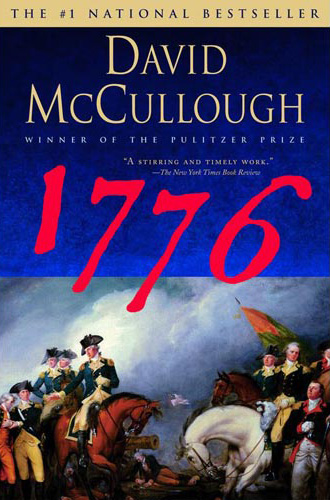
1776

ANOTHER David McCullough!

This is, I think, his most famous book.

In terms of reading about the wars of the United States of America, I grew up most interested in the Civil War and WWII. Getting older, I've added WWI and the Vietnam War to that list. I don't remember ever learning much of anything worthwhile about any of these conflicts in school. At least not before college. I remember vocab terms like rearm and blitzkrieg, but hardly anything about the Revolutionary War. I was in a play in summer children's theatre called Yankee Doodle that covered, among other things, the midnight ride of Paul Revere (Be up! Be armed! Be about!) But nothing much in school. This is weird because it is truly an incredible story and I would imagine there's some way in hell to get kids interested in how improbable this nation's very existence is ... but oh well, whatever, never mind.

1776 covers just that. It begins with the armies in Boston and ends with them a year later in New Jersey. In the middle of all of it, the colonies declare independence. McCullough sticks close to his sources, citing lots of journals and letters in his storytelling.

You'd think focusing on just one year of the war would help to clarify things, allowing the reader to focus for a thorough understanding of one part of the overwhelming whole. But I actually felt confused over and over again while reading this book, and I think I know why:

There were no good maps.

I admit I am (embarrassingly but not permanently) ignorant of this chapter in history. I don't have the same mental landmarks as I would when reading about the Civil War or WWII. I don't know many of the dates and hardly any of the terrain involved in the Revolutionary War. But I should be able to follow the text from battle to battle and siege to siege, even if I'd never set foot on U.S. soil.

Allow me to reference another grand history: The Lord of the Rings. That trilogy is outfitted with detailed and clearly labeled maps of the relevant areas of Middle Earth. You all know the ones I'm talking about. With the Tolkien font and the Misty Mountains and blah blah blah. Through all the density of those books, you always have a place to look to when you're feeling lost. Literally.

1776 could really have benefited from a few such maps. This sounds like such an old lady gripe, but it's true. The only maps provided are hard to read, split in half by the binding, and not well captioned. So what's the point? And it's demoralizing to find your self confused geographically when the place in question is Brooklyn Heights.

So there. I will try to read another book about the American Revolution before this year is out. Hopefully I will be able to provide some more insight at that point.

Till then: this book is definitely not a throwaway. The content is so incredible, again, that it's interesting as a whole. I just couldn't delve too deep for lack of orientation.