Sunday, January 17, 2010

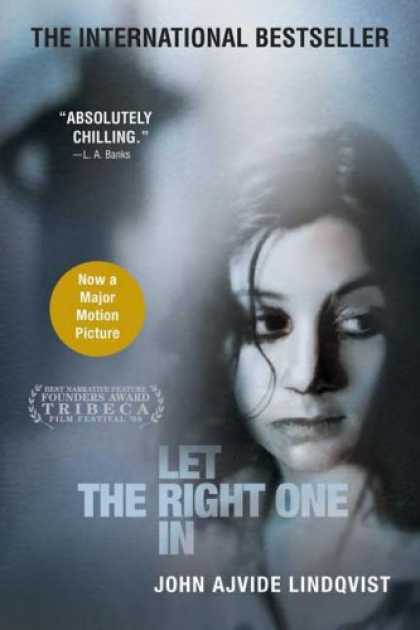
Let The Right One In


The main question here is: why did I pick this book up in the first place?

I was stranded in Evanston (a good answer to any question or accusation), done with one meeting and waiting around for an awkward amount of time until my next one. I needed something to read. Didn't feel like reading a periodical. Saw this book on sale. Remembered a couple of friends loved the movie. Reasoned that it was something decidedly different from my usual fare and bought it.

Of course, I really didn't like it very much at all. I thought at least I'd get a couple of deliciously suspenseful nighttime reads out of it, but I just wasn't into it. It occurred to me somewhere in the middle of this book that I have almost no "scary" books in my past. Of course I read Goosebumps. And Scary Stories. But other than that, I draw a blank. I definitely know the feeling of staying up way too late reading something that's freaking me out, or at least keeping me in suspense. What was it? Goosebumps? (Too long ago.) The Da Vinci Code? (Too many italics. Also too embarrassing.) Harry Potter? (Maybe I should go read the whole series again to make sure.)

But I must admit, I definitely remember my pulse quickening at some points during Dan Brown novels in a way that it never came close to doing during Let The Right One In. Overall, I was left feeling dull. I didn't experience any visceral or emotional response while reading this book. In fact, I just might have turned into a vampire. (Do vampires experience emotion? I'm not up on the trends or the lore.)

It's possible I just had the wrong impression. This book is less about gore and fear and vampires and more about kids growing up. Being bullied, abandoned, neglected; falling in love, developing muscles and independence. You know, that sort of thing. I'm usually into those themes. Here they fell flat for me, though. There were lots of gross details that somehow were only gross - not scary or imagination-firing or compelling. And there were too many different characters vying for my sympathy and investment - whatever small, potentially lovely moments there could have been became just part of the parade.

I do love the title. I have since watched the movie and thought it was beautiful visually and well adapted (those small lovely moments were more recognizable). It also had a knack for making things way scarier by holding back the visual details. Like: focusing on a character in the foreground as something violent and impossible happens in the far background, or in partial shadow. Ooh, shivers!

But back to the book. I would not recommend it, even if you're the type that usually likes to read the book before seeing the movie (I am). It was just one of those reading experiences that never materialized into something worthwhile. I would look forward to reading it, hoping for the best, but then never feel satisfied or engrossed.

Wah-wah. So much for trying new things.

Vampire Side Note: My cousin Alex (7) played an evil genius in his school play last spring. He took on the cackle we know as the laugh of that classic vampire The Count (THREE rotten apples! AH!-AH!-AH!) as one of his character attributes. The funny part: my other cousin Nathanael (1) picked up on the laugh too. So whenever Alex would do it, Nathanael would do the baby version. And they were both really good at it and looked happy as clams when they did it. I mean, that was adorable.

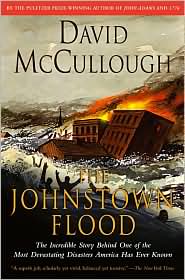
Hell Upside Down!

Johnstown, PA is famous for its floods.

I've always known a little bit about the town because my dad lived there until middle school. My dad took my sister and me for a ride on the Inclined Plane, which was built after the 1889 flood as a precaution for future flood victims. It did indeed save lives during later floods, but has mostly served commuting steelworkers and tourists.

The Inclined Plane is a huge steel car (it holds 65 people) that runs up the side of a huge hill (the track is 867 feet long) at a grade of 71%. You can board it in downtown Johnstown and ride it directly up to the residential neighborhoods high above the town, and vice versa. At the top is a little gift store where you can buy snow globes and mugs and things like that.

Johnstown's location is a little ridiculous. It's your basic flood bait:
The city was built on a nearly level flood plain at the confluence of two rivers, down at the bottom of an enormous hole in the Alleghanies. A visitor from the Middle West once commented, "Your sun rises at ten and sets at two," and it was not too great an exaggeration. (The Johnstown Flood, p. 24)
My grandma Cookie (Carol Schmidt) is buried in Grandview Cemetery - aptly named; this cemetery has some of the most breathtaking and somehow distinctly American views you'll ever find. Along with Cookie, most of the 2,209 victims of the 1889 Johnstown flood are buried at Grandview, overlooking lower Johnstown and the surrounding mountains. My Uncle Doug has already reserved and paid for his own future plot at Grandview. Nerd.

So, May 31, 1889. A dam bursts high above Johnstown, at the South Fork Fishing and Hunting Club (a summer resort for men like the Andrews Carnegie and Mellon). Behind the dam was an entire manmade lake; it had been a long-running joke in Johnstown and other surrounding towns that it was just a matter of time before the shoddily-made and already patched-up dam would give way.

The water from the dam and the two rivers rushed down the mountains, leveling everything in its way and gathering all kinds of terrible debris. The situation of the town was such that the water just shot down a wedge toward it, with nowhere for the water to spread out or slow down.

So, you can imagine. I'll leave the gory details to David McCullough.

Though there were two other major floods (in 1936 and 1977), this is the famous Johnstown Flood. 2,209 died; 777 remain unidentified.

I couldn't stop reading this book. The story is fascinating for obvious reasons. The astounding neglect and complacency leading up to the disaster brings to mind the situation in New Orleans before Hurricane Katrina (though the aftermath of this flood was of a much more honorable and efficient character...you know, as opposed to sick and disgraceful and embarrassing). The back story of the dam is kind of crazy, and worth reading in its own right.

Throughout, McCullough tells the story of the flood through the eyes of those that experienced it. In addition to the horror and human interest, there is a lot of humor in the book. My favorite little nugget:
[James] Walters had made one of the day's most extraordinary voyages, having been swept from his home on Walnut Street on top of a roof which took him spinning across town until he smashed into the side of Alma Hall, flew headlong through a window, and landed square in the middle of his own office. (p. 169)
If you're a fan of history, pick this up for sure. If not, you might still enjoy it. It's a quick read, not dense at all. Honestly, I'm not sure why the Johnstown Flood doesn't get more play. It's got everything: hubris, class controversy, tragedy, industry, courage, spectacular scenes, Americans Doing Good and Pulling Together, etc. I admittedly bring some personal weight to it as a reader, but I would recommend it heartily to anyone, family history or no.

Monday, January 11, 2010

When we all come together again...

Yo everybody!

So, Julie was talking about this last decade, and I know what you're all thinking, "Out with the old, in with the new." But wait! I happen to think that this particular idea still stands the test of time. But do you? Consider: What if we chose to act like a regular book club, just once, just for one single solitary book, and decided to all read the same thing? Is anybody super opposed? No? Good.

I've been brainstorming, ruminating, about that one perfect book that none of us have read but that all of us might enjoy reading. Here's a small list. You all should add suggestions as well, and then we can maybe pick one together, and embark!

1. Cloud Atlas ~ David Mitchell (since we all seem to have some kind of adoring love for Black Swan Green)

2. The Corrections ~ Jonathan Franzen (mom, have you read this? I feel like maybe you have...)

3. Zeitoun ~ Dave Eggers

4. The Museum of Innocence ~ Orhan Pamuk

5. Nocturnes ~ Kazuo Ishiguro

(What else? Somebody add more books to this list.)

The Dead Father

This is a pretty wonderful book, written by my favorite short story writer, Donald Barthelme, about the dragging of The Dead Father. Impulsive, childish, measuring approximately 3200 cubits in length, and also perhaps not quite yet dead, The Dead Father is forced to spend the end of his days being pulled by cable through cities and forests and medieval landscapes, all in the hopes of possibly retrieving the golden fleece before it's all over. The Dead Father plods. He wears long flowing robes. When he grows angry, he likes to slay things (harpists, squids, young goats) with his broad sword. He loves pontificating. He hates being old. The telling of this tale is surreal, angry, crackling with verbal delight. "Acidly ironic fantasy" is what The New York Times had to say. So good. So full of moments that make you laugh and moments that make you go hmmm. Donald Barthelme continues to impress.

Wednesday, January 6, 2010

A Friend of the Family

So sue me. I like a book about dysfunctional family members. "A Friend of the Family" fits the bill. Dr. Pete Dizinoff has a nice life....happy marriage, his best friend living close by, a close relationship with his one and only child, a thriving practice. Yet all is not what it seems. Many years ago, Pete's best friend's daughter, Laura, committed an unthinkable crime when she was 17 and now that she's 30, she has moved back home and has seduced Pete's 20 year old son, Alec, against every wish of Pete's. Everything falls downhill, Pete's marriage, his work, his relationships with his son and best friend, his reputation...everything spiraling out of control. To what lengths will a father go to protect his child? A little predictable..a little soap-opera-ish...a little easy on the brain. If you're in the mood for some family crisis though, this one's for you.

Eat food. Not too much. Mostly plants.

This is Michael Pollan's newest book, which I suspect is a hugely condensed fusion of The Omnivore's Dilemma and In Defense of Food (both by MP). In it, he quickly rails against the Western diet - the chemicals and additives and largely unknown future effects - and then proceeds to establish 64 Food Rules meant to help us break said diet, or at least begin the process.

If you have $11 or an hour to kill in a bookstore, I suggest reading this. I think the things mentioned in this book are worth thinking about, and I admittedly have given the subject almost zero thought in the previous decades of my existence. However, it's 2010 now, the future has arrived, so why not try to stir things up a bit (in a Sauce Pan. BOOM).

These are the 64 rules. I included them because I felt like typing something long and thoughtless (on my end). But you can read them. Or you can ignore them. You can read 1/3 of them and then go read the real book. Or you could have some lunch, save $11, and then use that money to buy one of Michael Pollan's deeper explorations into the complex world of food. I think that's where I'll be next. See you there?

PART I (Eat food.)
1. Eat food. (not edible foodlike substances)
2. Don't eat anything your great-grandmother wouldn't recognize as food.
3. Avoid food products containing ingredients that no ordinary human would keep in the pantry.
4. Avoid food products that contain high-fructose corn syrup.
5. Avoid foods that have some form of sugar (or sweetener) listed among the top three ingredients.
6. Avoid food products that contain more than five ingredients.
7. Avoid food products containing ingredients that a third-grader cannot pronounce.
8. Avoid food products that make health claims.
9. Avoid food products with the wordoid "lite" or the terms "low-fat" or "nonfat" in their names.
10. Avoid foods that are pretending to be something they are not.
11. Avoid foods you see advertised on television.
12. Shop the peripheries of the supermarket and stay out of the middle.
13. Eat only foods that will eventually rot.
14. Eat foods made from ingredients that you can picture in their raw state or growing in nature.
15. Get out of the supermarket whenever you can.
16. Buy your snacks at the farmers' market.
17. Eat only foods that have been cooked by humans.
18. Don't ingest foods made in places where everyone is required to wear a surgical cap.
19. If it came from a plant, eat it; if it was made in a plant, don't.
20. It's not food if it arrived through the window of your car.
21. It's not food if it's called by the same name in every language. (Think Big Mac, Cheetos, or Pringles.)

PART II (Mostly plants.)
22. Eat mostly plants, especially leaves.
23. Treat meat as a flavoring or special occasion food.
24. "Eating what stands on one leg [mushrooms and plant foods] is better than eating what stands on two legs [fowl], which is better than eating what stands on four legs [cows, pigs, and other mammals]." (but don't forget about the entirely legless fish!)
25. Eat your colors.
26. Drink the spinach water.
27. Eat animals that have themselves eaten well.
28. If you have the space, buy a freezer.
29. Eat like an omnivore.
30. Eat well-grown food from healthy soil.
31. Eat wild foods when you can.
32. Don't overlook the oily little fishes.
33. Eat some foods that have been predigested by bacteria or fungi.
34. Sweeten and salt your food yourself.
35. Eat sweet foods as you find them in nature.
36. Don't eat breakfast cereals that change the color of the milk. (goodbye delicious lucky charms...)
37. "The whiter the bread, the sooner you'll be dead."
38. Favor the kinds of oils and grains that have traditionally been stone-ground.
39. Eat all the junk food you want as long as you cook it yourself.
40. Be the kind of person who takes supplements - then skip the supplements.
41. Eat more like the French. Or the Japanese. Or the Italians. Or the Greeks.
42. Regard nontraditional foods with skepticism.
43. Have a glass of wine with dinner.

PART III (Not too much.)
44. Pay more, eat less.
45. ...Eat less.
46. Stop eating before you're full.
47. Eat when you are hungry, not when you are bored.
48. Consult your gut.
49. Eat slowly.
50. "The banquet is in the first bite."
51. Spend as much time enjoying the meal as it took to prepare it.
52. Buy smaller plates and glasses.
53. Serve a proper portion and don't go back for seconds.
54. "Breakfast like a king, lunch like a prince, dinner like a pauper."
55. Eat meals.
56. Limit your snacks to unprocessed plant foods.
57. Don't get your fuel from the same place your car does.
58. Do all your eating at a table.
59. Try not to eat alone.
60. Treat treats as treats.
61. Leave something on your plate.
62. Plant a vegetable garden if you have the space, a window box if you don't.
63. Cook.
64. Break the rules once in a while.

Friday, January 1, 2010

Eating Animals by Jonathan Safran Foer

Or "Only JSF Could Manage To Turn A Non-Fiction, Self-Reflective Evaluation of One's Individual Relationship With The Meat Industry Into a Multi-Narrator Literary Feast."

So I'm gonna be real honest here.

First Truth:
In his introduction, Foer writes "This book is...as objective as any work of journalism can be." I call bullshit. This book is bias bias bias bias, which I wouldn't have minded at all except that he set me up to expect something objective, which was not the case.

Second Truth:
Eating Animals is uber preachy, including but not limited to the use of one of my FAVORITE (and I use that word in a sarcastic and an unsarcastic way, simultaneously) devices, the comparison of one's personal crusade against whatever it is that one is crusading against to Rosa Parks and the Montgomery Bus Boycott.

Third Truth:
Foer relies on a lot of bleeding-heart tactics that don't really fly with me. I mean, I'm as anti-animal clubing as the next guy, but it's gonna take a lot more than talking about hurting a cow's feelings to get me to stop eating steak. I'm much more interested in the ecological and nutritional effects of factory farming/meat eating. Foer definitely explores this aspect as well, and that is where Eating Animals is the most compelling.

Fourth Truth:
I liked Eating Animals more than I liked Everything Is Illuminated.

Fifth Truth:
In spite of all its flaws, Eating Animals definitely does its job. Foer asks all the tough questions, and even though I arrived there via a very different route than he did, I don't eat meat anymore. Thanks a lot, Johnny Boy.