Saturday, January 31, 2009

Being Chuck Klosterman


My affinity (okay, Highsmithian obsession) for Chuck Klosterman has been documented earlier on this blog, so I went dwell on that again. And I know (or at least I believe, I'm too lazy to find the link) I listed this collection in my ten recommended books post, so its not like this was all new. But after enjoying IV so much, I decided to back up and reimmerse myself in the only other Klosterman lying around my apartment (besides the heavily-drugged-and-bound-in-a-large-sack-Audition-style author himself), Sex, Drugs, and Cocoa Puffs.

I love pop culture, and as an extension, I really enjoy well written pop culture criticism. It's why I spend so much time on the AV Club website (I actually confessed to two AV club writers I met the other day that I have trouble watching television programs that the website doesn't blog about, because I miss the outlet to confirm my opinions or the outrage disagreeing causes). And few, if any, do it better than Klosterman. While I think I enjoyed IV more, overall (partly because I found the interviews more interesting than the simply crticism pieces...he does Billy Joel in both of them, and comes to similar conclusions, but the essay in IV has the benefit of the fact that Klosterman discusses his conclusions about Billy Joel will never be "cool" with Billy Joel himself. SDandCP also contains the only Klosterman piece I've found that I actively disagree with, the one in which he argues against the idea and worthwhileness of soccer both as a passtime and a spectator sport. But his pieces on why our generation will forever be unsatisfied in relationships (because we watched too many John Cusack movies) and why Pamela Anderson is the new Marilyn Monroe (and what that says about America) are priceless, and I found another thing we have in common (a bizarre fascination with serial killers). And, if nothing else, Klosterman (a very white dude from middle america who now lives in NYC and makes money writing about popular things) can only be a great companion piece to Stuff White People Like.*


*While I have not checked SWPL out in book form, I have been a big fan of the blog for a while, and I am fairly confident that, by measure of both blog and book, I am the whitest contributor to this blog. But I'm willing to fight that one out.

Dook dook dook!

Hello dear friends.  It's been ages.  Let's rock this shit.

Maakies is a crazy-ass weekly comic strip that chronicles the adventures of Drinky Crow and Uncle Gabby, a sort of refined monkey-fellow.  They get blotto, kill things, and hurt themselves.  Sounds like me on New Years.  Yeergh.

This book is compendium of this fantastically freaky shit.

I work with children all day long.  They make me laugh and are adorable.  Then I go home and read Maakies and my mind twists in devilish ways.  Like what if a baby pooped out a treasure map that leads to a vast reserve of bonded bourbon?  Or what if that stuffed animal was alive and slowly digesting a beautiful mermaid deep within its stomach.  I can hear her screams now...thanks to Maakies.

I have to say I haven't been myself these past few months.  It's nice to know that when shit gets weird and sad, Maakies will undoubtedly be weirder and sadder and sillier.  Here's to drunken birds and sailing ships!!!

Dook dook dook 

Thursday, January 29, 2009

Stuff White People Like

Oy.

I'm so predictable! How did this happen? When did this happen? 

According to this book, I fall nicely into the 70% white category. Out of the 150 White Items in this book, I disliked 37 of them. The rest I either already like, or after reading their captions, immediately decided that I need to like them. Because I'm white. 

All The White Things That I Like:
Film Festivals, Assists, Farmer's Markets, Organic Food, Diversity, Barack Obama, Wes Anderson Movies, Asian Girls, Nonprofit Organizations, Tea, Having Black Friends (Pete Minta, where did you go??), Gifted Children, International Travel, Writer's Workshops, Microbreweries, Wine, Manhattan, 80's Night, Marijuana, Architecture, The Daily Show with Jon Stewart/The Colbert Report, Brunch, Renovations, Arrested Development, Netflix, Apple Products, Indie Music, Sushi, Plays, Public Radio, The Sunday New York Times, Liberal Arts Degrees, Whole Foods, Vintage, Irony, Sarah Silverman, Dogs, Kitchen Gadgets, Apologies, Lawyers, Documentaries, Natural Medicine, Toyota Prius, Bicycles, Expensive Sandwiches, Recycling, Coed Sports, Michel Gondry, Mos Def, Gentrification (is that so terrible?), Oscar Parties, Bottles of Water, Musical Comedy, Modern Furniture, The Idea of Soccer (because it totally sucks to watch on TV), Graduate School, Bad Memories of High School, T-shirts, Shorts, Outdoor Performance Clothes, Having Gay Friends, Dinner Parties, San Francisco, Music Piracy, New Balance Shoes, Beards, Red Hair, Non-Motorized Boating, Scarves, Self-Deprecating Humor, Integrity, The Criterion collection, High School English Teachers, Free Health Care, The New Yorker, Subtitles, Premium Juice, Plaid, Platonic Friendships, Reusable Shopping Bags, Acoustic Covers, Dave Chappelle, Nintendo Wii, Conspiracies, The Simpsons, Avoiding Confrontation, Following Their Dreams, Not Having Cash, Singer-Songwriters, Eating Outside, Books, Music Festivals, Glasses, McSweeney's, Hardwood Floors, Bakeries, Modern Art Museums, Public Transportation That Is Not a Bus, Dive Bars, Self-Importance, and Rock Climbing.

All The White Things That I Intend To Like Very Soon:
Coffee (it looks awesome and delicious, and I know that one day I'll most likely buckle under pressure), Yoga, David Sedaris, Wrigley Field, Living By The Water (sounds quite pleasant), Japan (never been, but plan on it!), Study Abroad (I guess I missed the boat on this one, but it seems like an incredible white journey on which to embark), The Wire, Having Children In Their Late Thirties (sounds like sound advice), Cleanses (the stomach kind), Portland, Oregon, and Therapy.

I guess I should be embarrassed about all of this, how my life can be so easily condensed into predictable list form. But then again, what about all of you? Don't you also feel a certain affinity towards these things? Netflix and dogs and being an expert on different kinds of cheese. Because, don't you see? WE are all white. Julie and Reggie and Ezekiel and Patrick and Joshua and Grant. And why can't we whites get together and celebrate all the wonderful things that we like? We're part of a giant club! There are millions of members! Lots of common interests! Don't you see?! WE ALL WIN!

Tuesday, January 27, 2009

Ripping Yarns

Years ago, in one of my every-few-years sprees of reading and re-reading Roald Dahl, I had the good luck to read his autobiography Boy, focused on his childhood growing up in the UK in the early years of the 20th century. It was, as I remember, a pretty keen and incisive take on the peculiar and rarefied world of boarding school, and it wasn't hard to find in it the roots of Dahl's fascination with childhood -- both its energetic possibilities and the limitless cruelty of children.

Going Solo picks up roughly where Boy leaves off, employing the same wide-eyed wonder as Dahl sets forth on a voyage to work for the Shell company in colonial Africa and, eventually, enlists as a fighter pilot when World War II breaks out. It's an interesting document of its time, the curiosities of which do not escape Dahl's attention. Throughout, he's overwhelmed by native culture, throwing himself into learning Swahili (and teaching his servants English, very much a taboo at the time, given the British concern about native uprisings) and fascinated by the rituals and customs of distant lands. It's classic ripping-yarns stuff, the like of which the British seem to particularly excel at, and falls prey to a certain limited condescention -- nothing in the book quite so much as Dahl's account of his house servant's bloody adventure when he hears that war has broken out against the Germans, with Dahl called away to round up the Germans in-country. There's a bemused superiority to the account of Mdisho's decapitation of a cruel neighbor German that bespeaks a certain superiority on Dahl's part. But by and large, these passages are more remarkable for Dahl's clear joy for the strangeness of the world in which he's found himself, untempered by a desire to control or correct it, eagerly dashing off whenever he gets the chance to lose himself in the unfamiliar and to escape attempts at bringing Brittain to all its empire controls.

The shift into WWII brings with it an incredibly British quality in its weary, grim clear-eyed view of the pointlessness and waste of war. Dahl is routinely stunned by the insanities of British command priorities (the bulk of the WWII fighting concerns the attempt to defend all of Brittain's forces in Greece with less than a dozen fighter pilots), occasionally takes stock at the vicious, steep bloodshed that cuts down nearly all the pilots he meets along the way, and is faced with a constant stream of inconceivable orders that follow no rational course, and have no perceivable outcome. There are no illusions here about the evils of Hitler (and there's one superb encounter Dahl has with a Jewish refugee in what will soon become Israel, in which Dahl is the butt of his own writing, ignorant at the time about the events of the Holocaust and totally clueless as to the roots of the Zionist movement) but that doesn't mean there's no gravity or weight to the horrible, gratuitous and ultimately bewildering losses sustained in the war.

Monday, January 26, 2009

Sideways Stories from Wayside School

14. Sammy

It was a horrible, stinky, rainy day. Some rainy days are fun and exciting, but not this one. This one stunk. All the children were wet and wore smelly raincoats. The whole room smelled awful. 
"Ooooh, it stinks in here," said Maurecia.
Everybody laughed. But she was right.
There was one good thing, however. There was a new boy in class. New kids are always fun. Except no one could even tell what the new boy looked like. He was completely covered by his raincoat.
"Class," said Mrs. Jewls. "I'd like you all to meet Sammy. Let us show him what a nice class we can be."
Leslie walked up and smiled at Sammy. But her smile quickly turned into a frown. "You smell terrible," she said.
"Leslie!" exclaimed Mrs. Jewls. "That's no way to greet a new member of our class." Mrs. Jewls wrote Leslie's name on the blackboard under the word DISCIPLINE.
"But he does, Mrs. Jewls," said Leslie. "He smells awful."
"You're ugly," Sammy replied.
"Now, Sammy, that's no way to talk," said Mrs. Jewls. "Leslie's a very pretty girl."
"She's ugly," said Sammy.
Allison spoke up. "Well, you smell terrible and are probably even uglier. But nobody can see you because you are hiding under that smelly old raincoat."
"That will be enough of that," said Mrs. Jewls. "Now, Sammy, why don't you take off your coat and hang it in the closet? Let us all see how nice you look."
"I don't want to, you old windbag," said Sammy.
"That's because he's so ugly," said Leslie.
"I'm sure he's quite handsome," said Mrs. Jewls. "He's just shy. Here, let me help you." Mrs. Jewls took off Sammy's coat for him. But underneath it was still another raincoat, even dirtier and smellier than the first one. 
They still couldn't see his face.
"Ooooh, now he smells even worse," said Maurecia.
"You don't exactly smell like a rose, either," Sammy replied.
Mrs. Jewls took off his second raincoat, but there was still another one under that. And the smell became so bad that Mrs. Jewls had to run and stick her head out the window to get some fresh air. 
"You're all a bunch of pigs!" Sammy screeched. "Dirty, rotten pigs!"
The smell was overpowering. Sammy just stood there, hidden under his raincoats.
Mrs. Jewls wrote Sammy's name under the word DISCIPLINE.
"Send him home on the kindergarten bus," said Joy.
"Not with me," said Todd.
Mrs. Jewls held her nose, walked up to Sammy, and removed his raincoat. She threw it out the window. But he had on still another one.
Sammy hissed. "Hey, old windbag, watch where you throw my good clothes!"
Mrs. Jewls put a check next to Sammy's name on the blackboard. Then she took off another raincoat and threw it out the window. The smell got worse, for he had on still another one.
Sammy began to laugh. His horrible laugh was even worse than his horrible voice.
When Sammy first came into the room, he was four feet tall. But after Mrs. Jewls removed six of his raincoats, he was only three feet tall. And there were still more raincoats to go.
Mrs. Jewls circled his name and removed another coat. She threw it out the window. Then she put a triangle around the circle and threw another one of his coats outside. She kept doing this until Sammy was only one-and-a-half feet high. With every coat she took off, Sammy's laugh got louder and the smell got worse.
Some of the children held their ears. Others could hold only one ear because they were holding their nose with the other hand. It was hard to say which was worse, the laugh or the smell.
Sammy stopped laughing and said, "Hey, old windbag, if you take off one more of my coats and throw it out the window, I'll bite your head off."
"They smell too bad for me to allow them in my classroom," said Mrs. Jewls. "You can pick them up when you leave."
"They smell better than you do, Pighead!" Sammy shouted.
Mrs. Jewls didn't stop. She took off another one of his coats, then another, and another. Sammy was only four inches tall, three inches tall, two inches tall. At last she removed the final coat.
All that was there was a dead rat.
"Well, I don't allow dead rats in my classroom," said Mrs. Jewls. She picked it up by the tail, put it in a plastic bag, and threw it away.
Mrs. Jewls didn't allow dead rats in her class. Todd once brought in a dead rat for show-and-tell, and Mrs. Jewls made him throw that one away, too.
"I'm glad Sammy isn't allowed in our classroom," said Rondi. "I didn't like him very much."
"Yes," said Mrs. Jewls, "we caught another one."
Dead rats were always trying to sneak into Mrs. Jewls's class. That was the third one she'd caught since September.

Saturday, January 24, 2009

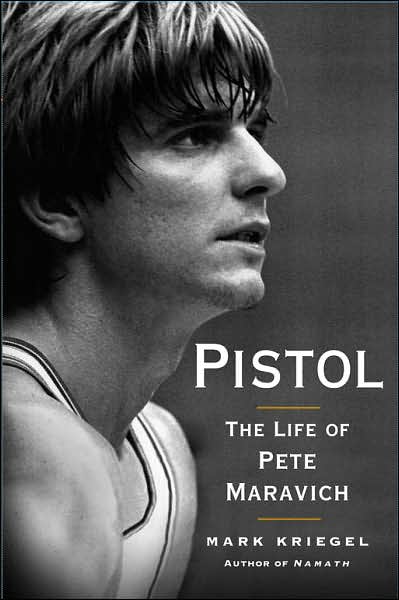
Pistol: The Life of Pete Maravich


If you are a college basketball fan, then you've heard of Pistol Pete. Playing in the 60's with no shot clock, no 3 point line, no freshman eligibility, and a slow down style of play, his stats have never, and probably will never, be equaled.

Oh yeah, he was born with only half the normal amount of coronary arteries, which usually results in complete inactivity and death by age 20. It did kill him when he was 41, however.


The Sporting News College Player of the Year (1970)
Naismith Award Winner (1970)
The Sporting News All-America First Team (1968, 1969, 1970)
Three-time AP and UPI First-Team All-America (1968, 1969, 1970)
Holds NCAA career record for most points (3,667, 44.2 ppg, three-year career) in 83 games
Holds NCAA career record for highest points per game average (44.2 ppg)
Holds NCAA record for most field goals made (1,387) and attempted (3,166)
Holds NCAA record for most free throws made (893) and attempted (1,152)
Holds NCAA record for most games scoring at least 50 points (28)
Holds NCAA single-season record for most points (1,381) and highest per game average (44.5 ppg) in 1970
Ranks 1st, 4th and 5th for most points in a single season in NCAA history, averaging 44.5 points in 1970, 44.2 points in 1969 and 43.8 points in 1968.
Holds NCAA single-season record for most field goals made (522) and attempted (1,168) in 1970
Holds NCAA single-season record for most games scoring at least 50 points (10) in 1970
Holds NCAA single-game record for most free throws made (30 of 31) against Oregon State on Dec. 22, 1969
Led the NCAA Division I in scoring with 43.8 ppg (1968); 44.2 (1969) and 44.5 ppg (1970)
The 44.5 ppg average ranks best in NCAA history; 44.2 ppg (fourth); 43.8 ppg (fifth)
Averaged 43.6 ppg on the LSU freshman team (1967)
Scored a career-high 69 points vs. Alabama (Feb. 7, 1970); 66 vs. Tulane (Feb. 10, 1969); 64 vs. Kentucky (Feb. 21, 1970); 61 vs. Vanderbilt (Dec. 11, 1969);
Holds LSU records for most field goals in a game (26) against Vanderbilt on Jan. 29, 1969 and attempted (57) against Vanderbilt
All-Southeastern Conference (1968, 1969, 1970)
Led LSU to the NIT Final Four in 1970, its first post-season appearance in 16 years
In 1988, Louisiana Governor Buddy Roemer signed legislation changing the official name of LSU's home court to the Maravich Assembly Center
In 1970, Maravich led LSU to a 20-8 record and a third place finish in the NIT
All-Time NCAA Career Scoring Leader with 3,667 points, an average of 44.2 points for 83 games.


Highlights

say NO to the suburbs!

My mom (who is now a secret reader of this blog) made me promise that I would read Revolutionary Road before seeing the movie. And so I did. If you're out there, mother, hello! Now go make me egg salad. 

This book is incredible. Reading it is comparable to the experience of a tightly clenched fist full of quarters repeatedly punching you in the same meaty part of your arm for hours and hours. First, it's not so bad, you can take the pain. Whatever. Soon it will stop, and you'll be able to tend to the chores of the day. Raking, washing, the cleansing of the gutter. But then it doesn't stop, the pain, that is, and you start to get all tender and sore, and your skin starts melting into a purple blackish mess of a bruise, and then your eyes start watering, and your contacts dislodge themselves so you can't see what's actually happening, and the pain gets louder, and all you want to do is lie down on the couch and eat your Ham & Cheese hot-pocket, but the fist persists, until finally, your arm just kind of falls off at the point of entry, and you see that your blood really is warm, but it's staining the freshly cleaned carpet, and will obviously have to be replaced, except you ran out of gas six days ago, and IKEA is DEFINITELY not in walking distance. So. Reading Revolutionary Road was kind of like that. In the best way possible.

It's about the suburbs, in the 50's, and the terribly terribly unhappy people that live there. Nothing monumentally exciting happens in this book. No giant plot twists. No rapist aliens. To some, that would seem a disappointment. But, I loved it. The way in which it's written is so good, full of these amazingly tight, claustrophobic sentences and paragraphs. It's told mainly through the point of view of Leo DiCaprio's character, but every once in a while, Richard Yates seamlessly jumps into the mind of the wife, or the children, or the real estate agent, which turns out to be a very cool method of storytelling. It was just an incredibly solid, beautifully written book, and every character, detail, and emotion in it seems uncomfortably real. 

I'm excited to see the movie, but I don't expect it to come even close to the brilliance that's contained in the novel. But we shall see.

Is my egg salad ready now?