Monday, April 12, 2010

The Hunger Games by Suzanne Collins

Or "This Book Gave Me Some Ideas About How We Should Structure Next Year's Fifty Books Club..."

Reading The Hunger Games, I was blissfully back to my ten-year-old self, my head under the covers, flashlight in hand, reading late into the night long after I was supposed to go to bed. It was engaging to the point of being addictive, and stirred up a genuine, passionate love of reading that I haven't felt in ages. My eyes couldn't read fast enough to satisfy my curiosity for what came next. You know that feeling? Being in third or fourth grade and being so engrossed in a story that you couldn't stop thinking about it, and couldn't wait until the next moment when you could grab hold of your book again? It happens so rarely to me these days. The Hunger Games was such a wonderful reminder.

The story takes place in Panem, a post-apocalyptic America, where our heroine sixteen-year-old Katniss Everdeen is left to fend for her family after her father is killed in a coal mining accident. This task is none to easy with the overwhelming restrictions the Capitol has put on District 12; even food is strictly regulated, and most of the residents are starving to death. We learn that, years ago, there was rebellion against the Capitol, in which the then-thirteen Districts fought back against their oppressive government. As you might have guessed, the Capitol won this rebellion, destroyed District 13 as a symbol of its power, and devised a horrible punishment to remind its subjects never to rebel again. Every year, two children from each district are chosen to compete in the Hunger Games, a televised Battle Royale in which the twenty four teens fight are forced to each other to the death. When Katniss's younger sister Prim is selected for the Games, Katniss volunteers to go in her place. And I'm going to leave it at that, because this book is genuinely such fun to read I would hate to spoil it.

Here's the thing. I didn't just love The Hunger Games. I also appreciated it. Collins does not shy away from the difficult subjects, even though this book is intended for younger readers. The language is sophisticated, the plot is emotionally challenging and thought-provoking, the characters are people you genuinely care about from start to finish. Collins examines the effects of war and violence on young people coming of age, our culture's sick obsession with watching others destroy themselves, the dangers of oppression - heavy themes handled with grace and a respect for the maturity and thoughtfulness of its young readers.

Oh, and it's really funny, too. I realize nothing about the plot or characters I've described seems like this would even remotely be the case, but it's true. It is full of warmth, tenderness and humor.

All I can say is THANK THE HEAVENS this is the first book in a trilogy, because I am certainly not ready to be done with the world of The Hunger Games.

Sunday, April 11, 2010

Cloud At Last

This is a beautiful book. Incredibly structured. Not one but six impeccably detailed universes that nestle inside one another, like matryoshka dolls, connecting and intertwining, all written in a completely different vernacular and genre. You start in one world, it's interrupted, you're transported to the next, which loosely ties into the first, and then it happens again, and again, until you find yourself floating across time like a soul with unfinished business, a soul looking for its true purpose.

One character, who's working on his magnum opus of a music composition, aptly titled Cloud Atlas Sextet, has this to say: "Spent the fortnight gone in the music room, reworking my year's fragments into a 'sextet for overlapping soloists': piano, clarinet, cello, flute, oboe, and violin, each in its own language of key, scale, and color. In the first set, each solo is interrupted by its successor: in the second, each interruption is recontinued, in order. Revolutionary or gimmicky? Shan't know until it's finished, and by then it'll be too late."

This is what he creates. To say more about the plot(s) would be to ruin the fun of blind exploration. But if you're a David Mitchell fan, or a lover of books with fantastic covers, consider picking this up. Maybe not quite as good as Black Swan Green (I was really excited for this to trump BSG, so I could prove Josh Lesser wrong once and for all, but sadly, Lesser wins the day), but truly a lovely novel to get lost in for a nice long while.

Thursday, April 8, 2010

Fast Food Nation by Eric Schlosser

Or "No I Would NOT Like Fries With That. Not Ever Ever Ever."

Everything about this book was surprising. The fact that Americans eat 68 pounds of beef a year each. The near-criminal working conditions in the meat packing industry. The vast and profound impact that the fast food industry has on virtually every aspect of our lives. But the most surprising thing of all was actually Schlosser's approach to the topic.

I have to give the man some serious kudos. He obviously has some strong opinions and a pretty clear agenda. But even with all that, Fast Food Nation never feels like it resorts to scare tactics or gross-out attempts as a way to get everyone in the world to stop eating fast food forever. I mean, after reading this book, I'm pretty sure that everyone in the world should stop eating fast food forever, but it feels like I arrived at that conclusion myself instead of being bullied into it. Because that's my major problem with these kinds of agenda-driven books and movies. It's so clear what they want you to think, that it can almost feel like a guilt trip.

Fast Food Nation doesn't creep into that territory at all. Though obviously strongly biased on the anti-fast food side of things, it's thoroughly researched, presented in a really straightforward way, and avoids impassioned, bleeding-heart rants about, well, anything. Truth be told, I was pretty shocked by how little of the book was devoted to "And here's the disgusting stuff that happens with the food!" compared to the politics, history, health implications, sleazy marketing tactics, etc. And for that, Mr. Schlosser, I applaud you.

I'm sure you are not surprised to hear me say that I think that Fast Food Nation should be mandatory reading. I'm not saying that I think you need to renounce fast food forever - I'm just saying that there's a lot of information to consider when making that decision, and Schlosser's thorough and utterly readable inquiry into the industry is a fantastic place to start.

I have to confess, though, that the first 100 pages or so just really made me want a hamburger...

Benjy by Edwin O'Connor

Or "A Kids' Book For People Who Hate Kids."

Little Benjamin Thurlow Ballou is the perfect little boy. He has a Mummy (a college graduate who wears her cap and gown when she walks her son to school), a Daddy (who is NOT a college graduate, as Mummy likes to point out), and an airedale named Sid (who politely reminds us that he has feelings, even if he can't talk). For being such a good little boy, Benjy is granted a wish and - as you might imagine - some backfiring ensues. Which all of us are grateful for, because Benjy is a velvet-suit-wearing, brown-nosing douche bag of a kid.

The actual secondary title of Edwin O'Connor's bitingly sarcastic not-quite-children's novel is "A Ferocious Fairy Tale." And ferocious it is. O'Connor is ruthless in his underhanded attacks of Mama's boys and the overly-loving Mamas who make them. I can't remember the last time I laughed out loud so much reading a book. Sadly, this 1957 gem is no longer in print, but used copies aren't too hard to find online if you're interested.

I don't have a copy of the book with me at the moment, but it's one that deserves excerpting. So at the next opportunity, I will leave a little sampling for you here.

To be continued...

CONTINUED! AS PROMISED! An excerpt, for your reading pleasure:

One night, almost a year ofter Benjamin Thurlow Ballou was born, Mummy put down one of the big heavy books she was always reading (she called them "texts") and said, "Daddy! I've been thinking about my little Benjamin Thurlow Ballou. His name is lovely but it's too hard."

"Too hard, dear?" said Daddy.

"Not for me," said Mummy, looking fondly at her diploma, which was beautifully framed and hanging on the wall. "But there are others around here who haven't had my advantages. I have to think of them."

"Yes dear," said Daddy. He had no diploma to look at, so all he could do was to look at the television set and hope that Sid the Airedale would not sneak over and grab the rest of his tongue and Swiss cheese sandwich.

"Besides," said Mummy, "in a few years now he'll be going to school and the little boys and girls he'll have to play with may very well have trouble with his full name. They may not be very bright. That's why I think we'd better give him some nice little nickname that no one will have any trouble with. I don't suppose you'd have any ideas about a nice nickname, would you"

As those last few words were said in Mummy's very special voice, Daddy thought for a few minutes. Then he said "How about George?"

"George," said Mummy. "I knew you'd say something like that. If some stranger on the street had come up to me and asked me what you'd say, I'd say that you'd say something like George!" She looked at her beautiful diploma again and gave a great big sigh. "Well," she said," at least one of us has an idea now and then. I know what we'll call him. We'll call him Benjy."

"Benjy," said Daddy. "That's nice, dear. That's very nice. Benjy."

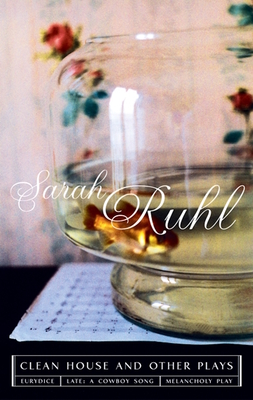
The Clean House and Other Plays by Sarah Ruhl

Or "Curiouser and Curiouser..."

I shall begin with a rationalization. Normally I don't like to count plays unless (a) they are Shakespeare and therefore sufficiently challenging and time consuming or (b) I am desperate. But in this case I am counting this as one of my books because it is a four-play volume, so I feel okay about the 4 Plays = 1 Book conversion factor.

As a playwright, Sarah Ruhl has her lovers and her haters. I had only ever read Eurydice (which I love), but after reading this volume I definitely see her polarizing effect. Her sense of whimsy can teeter on the edge of self-conscious, effortful, or overly clever, and not always to a satisfying end. I found The Clean House particularly challenging in that respect. In many ways the play is, although highly stylized in its form, pretty realistic and straightforward in its dialogue and characters. But then extraordinary, bizarre things happen, like a man carrying a tree that he has chopped down from Alaska (I think?) to his dying lover that disrupts the real(ish)ism in a not-entirely-seamless kind of way. Melancholy Play and Eurydice were more effective in terms of making Ruhl's surreality and lyricism an integrated part of the world, instead of a too-dominant style problem.

I do appreciate, though, how much Ruhl leaves up to the director, actor, and designers. Her stage directions and design suggestions are specific but not at all, giving the creators of each individual production quite a lot of freedom. As a director myself, I can definitely rally behind that level of trust - trust in her fellow artists as well as trust in her own material. The down side of that ambiguity (and I don't mean to be a Sour Kangaroo here) is that her material doesn't necessarily stand on its own, and in the hands of a bad director or sub-par actors, it could make for a pretty miserable evening of theater.

At the end of the day, this one woman jury is still out on whether I'm in the Sarah Ruhl Fan Camp or not. I'm interested to see how her style continues to evolve in the coming years.

Friday, April 2, 2010

EeeeeeYikes!!

I need to take a breath! I couldn't put this one down! My family's been neglected, the fridge is empty, my dogs are holding their legs together, the bananas have turned brown, my hair's coming in grey, it's suddenly spring outside. You get the picture and I don't need to add a thing to whatever everyone else who's read this book has said about it. It's THAT good! The Girl With The Dragon Tattoo......go read it.

Thursday, April 1, 2010

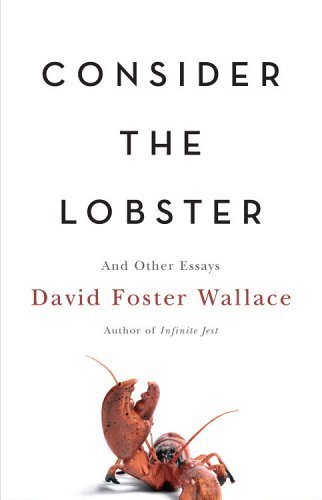
Consider the Lobster by David Foster Wallace

Or "Even The Footnotes Have Footnotes!"

Oh my goodness I am behind on posting! I don't even know if I remember all the things I've read! Well, I remember this one. So I guess I'll start here.

Consider the Lobster. Wow. How 'bout that. This review is quite a difficult one to write, because how do I possibly craft my insufficient prose to describe a writer who uses language with such eloquence and precision? Because, yeah. That guy knows his language. And I'm not even just talking about his review of A Dictionary of Modern American Usage (which, let's be honest, was hands down no contest without a doubt my number one nerdfavorite essay in the whole book). As I read, I was in constant awe of his command over the text - his ability to be detailed and eloquent and extremely dense in his subject matter, but without ever being convoluted.

Favorite essays included the Usage essay, as well as Up Simba. How Tracy Austin Broke My Heart had me snorting on the train I was laughing so hard. Just gonna say it... the last essay in the collection, Host, was a bit much for me. Maybe it was that the subject matter wasn't really up my particular alley, but that compounded with the sidenotes within sidenotes within sidenotes made for a difficult slog.

But, Host aside, my first run-in with ol' Dee Eff Dubs was more than positive, and I am oh so looking forward to devouring more.