Friday, April 17, 2009

Thanks Mom!


Jeannette Walls has a Mom.  I have a Mom too.  My Mom is a better Mom than her Mom is.

Thanks Mom!


Tuesday, April 14, 2009

sheep.

Hokay.

At the center of A Wild Sheep Chase is an unnamed narrator who is passive and somewhat unhappy with life. His wife just left him. A girl that he used to have sex with, but whose name he can't recall, just died in an accident. His cat is overweight and has weak teeth. His thoughts are occasionally consumed by a certain whale penis.

And then something happens (as things usually do). A man dressed in an immaculate black suit finds our narrator, and tells him that he has one month to find a mysterious sheep with a star on its back. One month. All of Japan. His life depends on it. So the unnamed narrator sets off on a journey, accompanied by his new girlfriend with curious ears, to find this sheep.

This was a very cool book. It was my first Haruki Murakami novel, so I didn't quite know what to expect. But now I do. There are so many cool details and phrases and storytelling devices crammed into this novel. Sheep and frozen seagulls, red wires and green wires, a mirror that might be actual reality.

This is one of Murakami's earlier novels (I think possibly the first one to be translated into English), and at times you can tell. It maybe feels a bit long, maybe a little too wordy. But only at times. And it really doesn't matter anyway, because at the essence of everything, this is a story about finding the most evil sheep in the world. And what about that doesn't sound incredible?

Mmm. Lamb chops.

Birds and Sadness

We talk about this book all the time. It's been my favorite book since the moment I finished it. But that was four years ago. I thought it might be time to return.

I'm very happy to report that it's still unbelievable. I was worried that I might have soured over the years, and that my pure love for Extremely Loud & Incredibly Close that I carry around with me always was actually nothing more than naive innocence. I was worried that my bubble was going to burst, and that I would have to find a new book to call my favorite book.

But I don't! The bubble is still there. Round and soapy! Extremely Loud & Incredibly Close remains victorious. Everyone wins. 


Baseball as a foundation for Ragnarok

Hey, bookish chums! Wow, I haven't written or read anything in ages! (I've read SOME things, just not "books." Terrible plays, mostly. Less rewarding, as it turns out, than you'd think!)

So here I'm back with this sprawling epic of a classic young-person's fantasy novel, from everybody's favorite creator of unique worlds, Michael Chabon. There's something really delightful about the way Chabon builds the environments in which his novels unfold (at least Kavalier and Clay and Yiddish Policeman's Union; I haven't read Wonder Boys yet, but presumably it, um, works wonders on Pittsburgh?). Elaborate detail underlies YPU's Jewish community of exiles in Alaska -- easily half the joy of the book is tracing Chabon's comprehensive working-through of the geographical and behavioral attributes of the alternate-timeline's settlement. And Summerland follows that model in exploring an island community located at a point connecting our reality and a host of others, all jam-packed with a dizzying amount of detail and attention.

It's a mashup of Norse mythology ("Ragged Rock" replacing Ragnarok), Native American mythology (Coyote serving as the principal villain), classic post-colonial American mythology (a community of tall-tales figures, a Sasquatch, etc.) and sweet, sweet baseball, which Chabon clearly loves. To the extent that you're looking for a book containing both references to trickster gods and clever riffs on Bill James's SABR organization, this is your book.

That said, even running a little over 500 pages, the book's a little cramped for space -- there are so many lands, characters and worlds encountered that it begins to feel a little like a montage rather than a full-fledged story, especially as the book heads into its climax and through its denouement. Breaking the book into multiple volumes would probably have been structurally problematic, and I'm sure there's an upper limit for how many pages a publisher would prefer Chabon take on what's ostensibly a children's novel (albeit in the Tolkein mold more than what passes for kids' lit today), but it would have been nice to see these cats breathe a little more than they do.

Guys, it has been real. I will see you when next I post (mid-August 2012, I believe).

Monday, April 6, 2009

Eight is Great

I read this book. Just wanted you all to know that.

Sunday, March 29, 2009

Back in the King of Things

Hello hello!

Picking up a Stephen King novel is like eating a mom-packed picnic...it's easy comforting fun that makes your stomach churn a little bit.

Yum.  Good to be back.


Friday, March 27, 2009

Is this Book Only Awesome Because I was Expecting it to Be?


I've developed a kind of affinity in the recent past for books that destroy my faith in things (religion, the country, other people, etc.) and this one os no different.
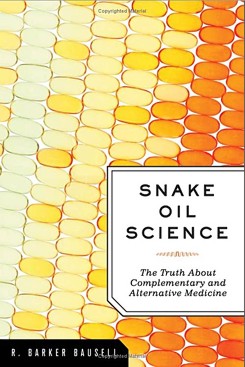
Grant already reviewed this one, so I won't go too in depth. I kind of feel like the book's title i a bit of a misnomer simply because "Snake Oil Science" conjured up the image of dastardly characters in old-west stories trying to sell cat urine to balding men. What the book is really about is the placebo effect and how it plays into the supposed effectiveness of CAM therapies. The author makes it very clear that most proponents of CAM therapies are not dishonest, but misled.
The only other thing I thought was weird was that after spending 300 pages talking about why CAM therapies don't actually have a chemical of biological effect on the body, he says in the last chapter that we should use them anyway because the placebo effect will make them seem like they're working. (that is, unless you read the book....)
Still, all-in-all, it's kind of dense and boring sometimes, but it's pretty cool stuff and will save me a lot of money on magnets. 6.5/10